KX
KXO 原生KXO API Token Console
Create owned Agentic OS API tokens with quota context.
核心
Agentic OS 生态全景
CNCF Landscape 的价值在于把复杂生态变成可搜索的运行地图。这个 Agentic OS 生态全景图也采用同样思路,帮助团队理解编码 Agent、研究 Agent、浏览器 Agent 和内部自动化背后的 API Token、路由、工具和治理层。

9
ecosystem categories
36
mapped surfaces
4
operational layers
每个分区都代表生产级 Agentic OS API Token 需要协调的生态面。KXO 位于访问与控制平面,让 Agent 代码保持一个稳定凭据,同时让运营者调整路由、额度和归属。
参考图
向团队解释 Agentic OS API Token 如何连接生态系统时,可以直接使用这些图。
层级: Core access plane
Where operators issue, scope, rotate, revoke, and audit Agentic OS API token access before agents reach production.
Create owned Agentic OS API tokens with quota context.
核心
Account sessions and operator identity for the SaaS layer.
核心
Dedicated non-human identities for production agents.
控制
Copy-once token visibility and revocation history.
控制
层级: Model relay plane
The upstream model providers, fallback groups, and relay policies that sit behind a stable Agentic OS API token.
High-reasoning model access through managed routing.
核心
OpenAI-style API access for agent runtimes and SDKs.
核心
Backup model groups when a primary route is unavailable.
控制
Token-level usage accounting for spend visibility.
控制
层级: Agent runtime plane
Frameworks that turn model access into planning, tool use, delegation, memory, and multi-step agent workflows.
Graph-based agent state machines and tool loops.
运行时
Data-aware retrieval, indexes, and agent workflows.
运行时
Multi-agent orchestration and delegated workflows.
运行时
Role-based agent crews for repeatable tasks.
运行时
层级: Work execution plane
Coding, review, and terminal agents that need reliable model access, cost boundaries, and auditable work sessions.
Coding agent workflows that need stable model calls.
交付
Terminal-based development flows with governed access.
交付
IDE agent sessions with budget and routing needs.
交付
Automated checks and review loops in delivery pipelines.
交付
层级: Tool interface plane
The protocols and connectors that let agents reach files, browsers, SaaS apps, search, code, and internal systems.
Tool and context servers attached to agent runtimes.
运行时
Computer use, browsing, capture, and web automation.
运行时
Team workflows and notifications for agent operations.
交付
Repository, pull request, and issue automation surfaces.
交付
层级: Context plane
Vector stores, files, caches, and context registries that keep long-running agents grounded without leaking credentials.
Retrieval memory for documents, code, and knowledge.
运行时
Durable file storage for outputs and attachments.
交付
Session state, queues, rate limits, and runtime caches.
运行时
Versioned prompts for repeatable agent behavior.
控制
层级: Control plane
The dashboards, alerts, cost reviews, and traces teams need before agent work becomes expensive or opaque.
Token-level usage review for operators and teams.
控制
Spend guardrails before agents run beyond intent.
控制
Traffic analytics for public product surfaces.
控制
Readable access trails for incident and finance review.
控制
层级: Delivery plane
Where agents show up for users: internal automations, product features, customer support, research, and ops workflows.
Scheduled and event-driven automation flows.
交付
No-code business process automation with model calls.
交付
Product-facing agents with quota-aware access.
交付
Long-session investigation and synthesis workflows.
交付
层级: Infrastructure plane
Cloud and runtime infrastructure for hosting the SaaS surface, relay backend, caches, databases, and agent delivery workflows.
Global SaaS edge runtime for the public console.
交付
Service orchestration for relay, Redis, and MySQL.
交付
SaaS application data and product configuration.
核心
Persistent relay-side users, keys, quota, and usage.
核心
Agentic OS ecosystem overview
A wide map of model access, token control, runtimes, memory, tools, and delivery surfaces around one governed API token plane.
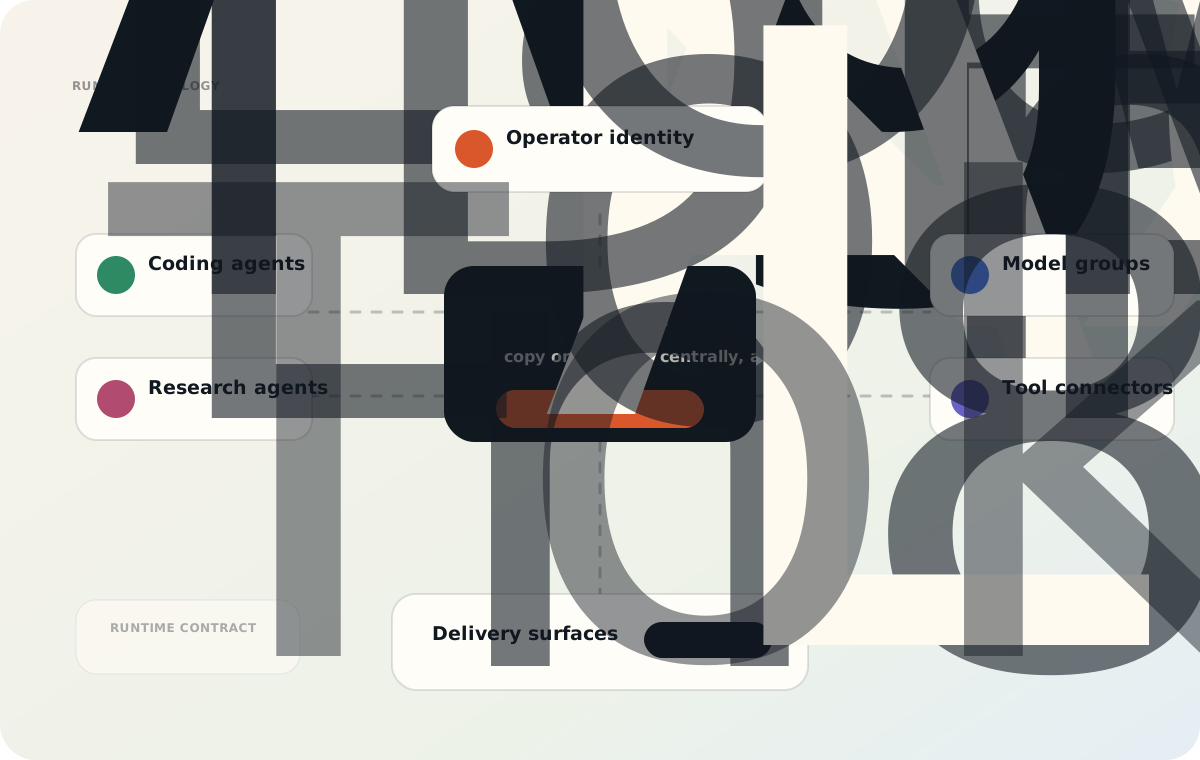
Runtime topology
A topology view showing how coding agents, research agents, browser agents, and internal automations call models through KXO.

Governance map
A control-plane diagram for ownership, quota, revocation, observability, billing, and audit trails around Agentic OS API tokens.
创建 KXO API Token,绑定 Agent 需要的模型路由,并从第一天开始看清额度、负责人和撤销策略。